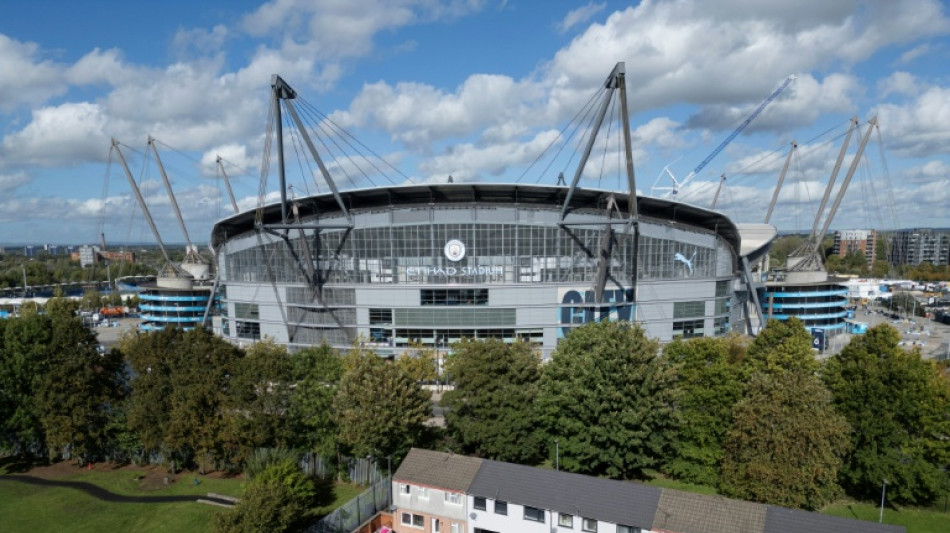
More than just football: How scandal-tainted City led Manchester's rebirth / Photo: Oli SCARFF - AFP

 London
 14 °C
14 °C

 Manchester
 15 °C
15 °C
 Glasgow
9 °C
Glasgow
9 °C
 Dublin
16 °C
Dublin
16 °C
 Belfast
16 °C
Belfast
16 °C
 Washington
 15 °C
15 °C
 Denver
22 °C
Denver
22 °C
 Atlanta
20 °C
Atlanta
20 °C
 Dallas
24 °C
Dallas
24 °C
 Houston Texas
26 °C
Houston Texas
26 °C
 New Orleans
26 °C
New Orleans
26 °C
 El Paso
23 °C
El Paso
23 °C
 Phoenix
33 °C
Phoenix
33 °C
 Los Angeles
25 °C
San Diego
24 °C
San Francisco
17 °C
Chicago
Los Angeles
25 °C
San Diego
24 °C
San Francisco
17 °C
Chicago
 16 °C
Minneapolis
13 °C
Seattle
15 °C
Portland
20 °C
Salt Lake City
20 °C
Las Vegas
30 °C
Miami
28 °C
Jacksonville
24 °C
San Antonio
26 °C
Bermuda
26 °C
Nassau
17 °C
Iqaluit
16 °C
Minneapolis
13 °C
Seattle
15 °C
Portland
20 °C
Salt Lake City
20 °C
Las Vegas
30 °C
Miami
28 °C
Jacksonville
24 °C
San Antonio
26 °C
Bermuda
26 °C
Nassau
17 °C
Iqaluit
 0 °C
Yellowknife
4 °C
Anchorage
7 °C
Fairbanks
0 °C
Barrow
-8 °C
Calgary
9 °C
Edmonton
15 °C
Winnipeg
9 °C
Goose Bay
13 °C
Halifax
9 °C
Boston
14 °C
Ottawa
10 °C
Toronto
11 °C
Detroit
14 °C
Cleveland
12 °C
New York
17 °C
Baltimore
15 °C
Philadelphia
15 °C
Nuuk (Godthåb)
0 °C
Yellowknife
4 °C
Anchorage
7 °C
Fairbanks
0 °C
Barrow
-8 °C
Calgary
9 °C
Edmonton
15 °C
Winnipeg
9 °C
Goose Bay
13 °C
Halifax
9 °C
Boston
14 °C
Ottawa
10 °C
Toronto
11 °C
Detroit
14 °C
Cleveland
12 °C
New York
17 °C
Baltimore
15 °C
Philadelphia
15 °C
Nuuk (Godthåb)
 0 °C
Hong Kong
28 °C
Singapore
31 °C
Melbourne
25 °C
Canberra
0 °C
Hong Kong
28 °C
Singapore
31 °C
Melbourne
25 °C
Canberra
 21 °C
Adelaide
21 °C
Adelaide
 19 °C
Darwin
31 °C
Perth
18 °C
Fort Worth
25 °C
Honolulu
27 °C
Sydney
24 °C
Johannesburg
15 °C
Dubai
31 °C
Mumbai
32 °C
Zürich
10 °C
Tokyo
19 °C
Darwin
31 °C
Perth
18 °C
Fort Worth
25 °C
Honolulu
27 °C
Sydney
24 °C
Johannesburg
15 °C
Dubai
31 °C
Mumbai
32 °C
Zürich
10 °C
Tokyo
 24 °C
Seoul
23 °C
Delhi
28 °C
Beijing
21 °C
Riyadh
26 °C
Prague
8 °C
Pennsylvania
11 °C
Valletta
25 °C
Manama
32 °C
Warsaw
10 °C
Stockholm
11 °C
24 °C
Seoul
23 °C
Delhi
28 °C
Beijing
21 °C
Riyadh
26 °C
Prague
8 °C
Pennsylvania
11 °C
Valletta
25 °C
Manama
32 °C
Warsaw
10 °C
Stockholm
11 °C
Standing behind the counter of his fish-and-chip shop near the Etihad Stadium, Sailish Parekh says the transformation of east Manchester over the past two decades has been remarkable.
Manchester City "has not only just been a football club for the area. It's a bit of a saviour, to be honest," he told AFP.
Before City -- now embroiled in the biggest financial scandal to hit football's cash-rich Premier League -- moved to the area it was "very deprived" with high rates of unemployment, he said.
Since the club's takeover by deep-pocketed Abu Dhabi investors in 2008, long-neglected districts between the stadium and the city centre have become symbols of the northern city's rebirth.
Decades of decline linked to deindustrialisation have been reversed.
In neighbourhoods such as Ancoats and New Islington, red-brick warehouses still stand as reminders of Manchester's industrial past.
But many disused mills and factories have given way to apartment blocks, trendy cafes and co-working spaces.
Software engineer Simon Martin, 44, who lives in Ancoats, recounted how a cab driver told him he would have hesitated once to pick him up, when the area was riddled with crime.
Today, Martin praises the "really nice community" with "more young families moving in", although soaring rents have pushed out some lower-income residents.
The transformation reflects the influence of Manchester City and its owner, Abu Dhabi United Group (ADUG), controlled by Sheikh Mansour bin Zayed al-Nahyan, a member of the United Arab Emirates royal family.
The Emirati investors have not just turned City into one of Europe's dominant football clubs.
They have also poured money into property development, building homes and commercial spaces on council-owned land leased under favourable terms.
The partnership is centred on Manchester Life, a property company created jointly between ADUG and the council in 2014, but it has drawn criticism over transparency and profit distribution.
In a 2024 study, University of Sheffield researchers argued the arrangement primarily enabled the ADUG group to lock in rising land values.
- 'Our Eiffel Tower' -
The city council rejects the criticism, saying it secured "the best overall deal" at a time when investors were scarce after the 2007-2008 global financial crisis.
According to the council, the partnership delivered around 1,500 homes and nearly 2,800 square metres (30,100 square feet) of commercial space.
The debate has resurfaced after the Premier League announced last week that an independent commission had found the club guilty on more than 100 charges of breaking financial rules.
It has been accused of artificially inflating revenues and reduced reported costs by more than £900 million ($1.2 billion) between 2009 and 2018.
No sanction has yet been announced but City could face substantial points deductions, a fine or even expulsion from the Premier League. It could also face compensation claims from other clubs.
City insists it has done nothing wrong.
With both Manchester City and rivals Manchester United having huge international draw, football is one of the city's defining assets, said Subrahmaniam Krishnan-Harihara, head of research at the Greater Manchester Chamber of Commerce.
"This is our Eiffel Tower. I think without football, the brand value would not be this big," he told AFP.
According to consultants EY, Premier League-related activity generates around £1.6 billion ($2.1 billion) in annual revenues across Greater Manchester.
The city also attracts about 1.7 million overseas visitors each year.
Manchester City was a "catalyst" for infrastructure projects, including the expansion of the tram network, said Krishnan-Harihara.
- Overcoming austerity -
Club officials say more than £700 million has been invested since 2008 in the Etihad Campus and surrounding districts, where sports facilities, a sixth-form college, a velodrome, retail developments and the Co-op Arena concert venue have emerged.
The Abu Dhabi investors were "key", said Georgina Blakeley, a professor at the University of Huddersfield who highlighted the impact of the 2007-2008 crash.
"You really get that turning off of the tap of regeneration activity ... and austerity hit cities like Manchester particularly hard," she said.
The Manchester Life project became part of the so-called "Manchester model", an urban development strategy championed by the council in the early 2000s and backed by Andy Burnham, the Greater Manchester mayor from 2017 to 2026 who is now UK prime minister.
Burnham sparked controversy recently when he said he would be "really concerned" should the Emirati owners walk away over the finance charges.
His office later sought to clarify the remarks, insisting "there can't be any suggestion that anyone is above the rules".
But Krishnan-Harihara believes any sanctions imposed on the club are unlikely to inflict lasting damage on Manchester's economic prospects.
"The foreign direct investment pool is actually widespread because there are other countries, other sectors which are also attracting investment," he said.
Fish-and-chip shop owner Parekh agreed. Manchester is now "quite a lot" more than "the two football clubs," he argued.
C.Weber--BlnAP