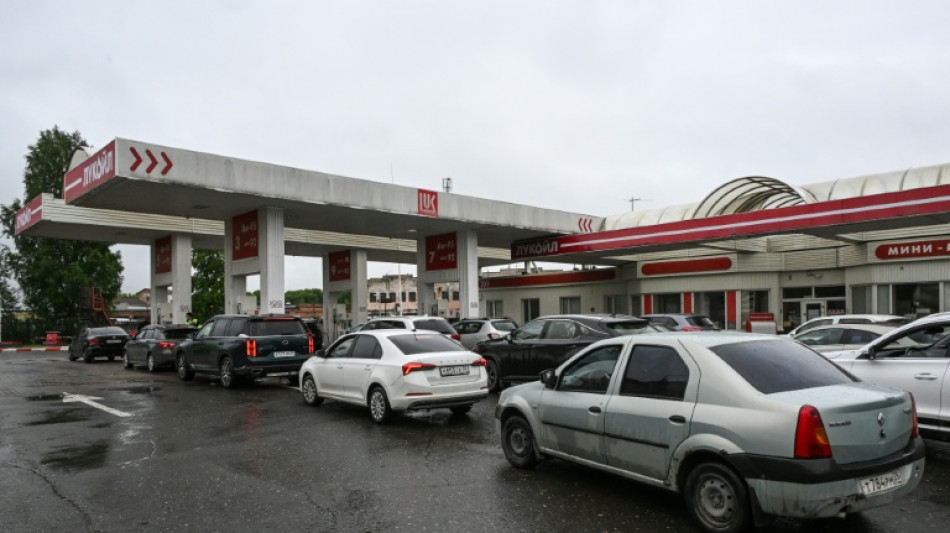
No fuel, no patience: Russians endure fuel shortages / Photo: Igor IVANKO - AFP

 London
 20 °C
20 °C
 Manchester
 16 °C
16 °C
 Glasgow
 18 °C
18 °C
 Dublin
17 °C
Dublin
17 °C
 Belfast
14 °C
Belfast
14 °C
 Washington
22 °C
Washington
22 °C
 Denver
18 °C
Denver
18 °C
 Atlanta
 20 °C
20 °C
 Dallas
27 °C
Dallas
27 °C
 Houston Texas
27 °C
Houston Texas
27 °C
 New Orleans
27 °C
New Orleans
27 °C
 El Paso
20 °C
El Paso
20 °C
 Phoenix
24 °C
Phoenix
24 °C
 Los Angeles
20 °C
San Diego
21 °C
San Francisco
16 °C
Chicago
20 °C
Minneapolis
15 °C
Seattle
Los Angeles
20 °C
San Diego
21 °C
San Francisco
16 °C
Chicago
20 °C
Minneapolis
15 °C
Seattle
 12 °C
Portland
14 °C
Salt Lake City
20 °C
Las Vegas
25 °C
Miami
26 °C
Jacksonville
26 °C
San Antonio
25 °C
Bermuda
29 °C
Nassau
23 °C
Iqaluit
3 °C
Yellowknife
12 °C
Portland
14 °C
Salt Lake City
20 °C
Las Vegas
25 °C
Miami
26 °C
Jacksonville
26 °C
San Antonio
25 °C
Bermuda
29 °C
Nassau
23 °C
Iqaluit
3 °C
Yellowknife
 7 °C
Anchorage
7 °C
Anchorage
 8 °C
Fairbanks
8 °C
Barrow
-1 °C
Calgary
7 °C
Edmonton
24 °C
Winnipeg
6 °C
Goose Bay
15 °C
Halifax
20 °C
Boston
20 °C
Ottawa
16 °C
Toronto
18 °C
Detroit
17 °C
Cleveland
22 °C
New York
23 °C
Baltimore
8 °C
Fairbanks
8 °C
Barrow
-1 °C
Calgary
7 °C
Edmonton
24 °C
Winnipeg
6 °C
Goose Bay
15 °C
Halifax
20 °C
Boston
20 °C
Ottawa
16 °C
Toronto
18 °C
Detroit
17 °C
Cleveland
22 °C
New York
23 °C
Baltimore
 22 °C
Philadelphia
23 °C
Nuuk (Godthåb)
5 °C
Hong Kong
28 °C
Singapore
30 °C
Melbourne
28 °C
Canberra
5 °C
Adelaide
11 °C
Darwin
22 °C
Philadelphia
23 °C
Nuuk (Godthåb)
5 °C
Hong Kong
28 °C
Singapore
30 °C
Melbourne
28 °C
Canberra
5 °C
Adelaide
11 °C
Darwin
 27 °C
Perth
19 °C
Fort Worth
26 °C
Honolulu
26 °C
Sydney
11 °C
Johannesburg
26 °C
Dubai
37 °C
Mumbai
30 °C
Zürich
20 °C
Tokyo
21 °C
Seoul
25 °C
Delhi
32 °C
Beijing
23 °C
Riyadh
40 °C
Prague
20 °C
Pennsylvania
22 °C
Valletta
29 °C
Manama
38 °C
Warsaw
18 °C
Stockholm
16 °C
27 °C
Perth
19 °C
Fort Worth
26 °C
Honolulu
26 °C
Sydney
11 °C
Johannesburg
26 °C
Dubai
37 °C
Mumbai
30 °C
Zürich
20 °C
Tokyo
21 °C
Seoul
25 °C
Delhi
32 °C
Beijing
23 °C
Riyadh
40 °C
Prague
20 °C
Pennsylvania
22 °C
Valletta
29 °C
Manama
38 °C
Warsaw
18 °C
Stockholm
16 °C
Russian couple Yelena and Dmitry passed four petrol stations before finally finding one that actually had fuel as they returned to the city of Vologda, some 300 miles (480 kilometres) north of Moscow, from their country allotment plot.
Like all but a few Russian regions, Vologda is suffering from fuel shortages, as intensifying Ukrainian strikes on Russian depots disrupt ordinary life more than at any point since the conflict began in 2022.
The crisis is unprecedented in Russia -- one of the world's top oil producers -- where fuel had until now been readily available and far cheaper than in Europe.
But for several weeks, queuing for petrol has become a staple of life during the dragging Ukraine conflict, causing impatience at petrol stations.
"What a horrible situation," fumed Yelena, as the couple waited in their car. "Now we wait. We'll see if there's any petrol left."
The Kremlin has downplayed the crisis, saying it was not critical, with President Vladimir Putin warning Ukraine was trying to divide Russians and cause panic.
But, far from the corridors of power, drivers were unhappy.
Cars are the main mode of transport in most regions of the world's largest country, where distances to cover are huge.
Since June, more than 90 percent of Russian regions have experienced fuel rationing or shortages, according to an AFP tally based on media reports and official statements.
Some petrol stations in Vologda were closed while others -- mostly owned by Russia's main oil giants -- saw drivers clustered in long queues.
- Improvement? -
Faced with the crisis, Moscow first banned exports of certain grades of petrol and aviation fuel. Last week, the ban was extended to diesel exports. Fuel rationing has also been introduced.
Some of these measures have started to work in Moscow and other regions in recent days, according to drivers and AFP observations.
In the capital, queues have shortened.
And in Vologda, Nikolai, a motorist who declined to give his surname, said "more stations have started working again, and petrol deliveries have become more frequent. Naturally, the queues have shrunk".
Vologda regional authorities did not respond to a request for comment.
Still, the shortages have shown how far Ukrainian strikes can derail Russia's oil sector.
In a report published in early July, Energy Intelligence, a US-based energy research firm, estimated that "nearly half of Russia's 6.6 million barrels per day of refining capacity... has been knocked offline since late February," as Ukraine stepped up its strikes on energy infrastructure.
- 'Who wants war?' -
Ukraine casts its strikes on Russian energy infrastructure as a response to Moscow's deadly bombardments of its cities.
They are also a way for Kyiv to choke off a source of revenue that Russia uses to fund the war.
Putin has sought to reassure the Russians.
Ukraine "is trying to harm" the Russian economy and "create a climate of nervousness in society," he said last week -- but it will not succeed, because "the safety margin of the Russian energy network is very high".
Vologda, some 1,000 kilometres from Ukraine, is nonetheless feeling the consequences of the offensive Moscow launched in February 2022.
Drivers in Vologda blamed the West, echoing the Kremlin's narrative of the war.
"It's because your allies are bombing us," Yegor, who asked his name to be changed, told AFP journalists.
"Who wants war? Ukraine, Europe..." he added, sitting in an SUV with his poodle, Bonya, on his lap.
He repeated Putin's rhetoric that Russia -- which sent troops to Ukraine in 2022 --"is only defending itself" against "decadent" Western countries ranged against it.
From the passenger's seat, Yegor's wife, settled into the car's leather seats, chimed in.
"Some people say we want to attack other countries. This is nonsense. Russia has never attacked anyone," she said.
A.Freund--BlnAP