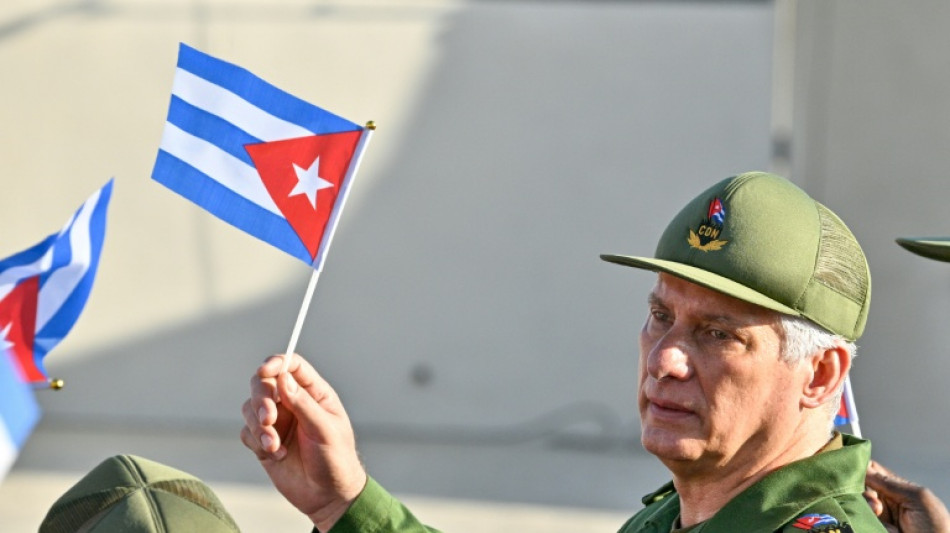
Cuba's communists meet to fast-track liberal reforms / Photo: ADALBERTO ROQUE - AFP

 London
 22 °C
22 °C
 Manchester
20 °C
Manchester
20 °C
 Glasgow
 16 °C
16 °C
 Dublin
20 °C
Dublin
20 °C
 Belfast
19 °C
Belfast
19 °C
 Washington
16 °C
Washington
16 °C
 Denver
 13 °C
13 °C
 Atlanta
22 °C
Atlanta
22 °C
 Dallas
25 °C
Dallas
25 °C
 Houston Texas
26 °C
Houston Texas
26 °C
 New Orleans
 23 °C
23 °C
 El Paso
24 °C
El Paso
24 °C
 Phoenix
28 °C
Phoenix
28 °C
 Los Angeles
18 °C
San Diego
20 °C
San Francisco
14 °C
Chicago
14 °C
Minneapolis
Los Angeles
18 °C
San Diego
20 °C
San Francisco
14 °C
Chicago
14 °C
Minneapolis
 10 °C
Seattle
14 °C
Portland
15 °C
Salt Lake City
18 °C
Las Vegas
21 °C
Miami
26 °C
Jacksonville
23 °C
San Antonio
25 °C
Bermuda
28 °C
Nassau
15 °C
Iqaluit
-2 °C
Yellowknife
9 °C
Anchorage
7 °C
Fairbanks
3 °C
Barrow
1 °C
Calgary
12 °C
Edmonton
19 °C
Winnipeg
6 °C
Goose Bay
7 °C
Halifax
14 °C
Boston
14 °C
Ottawa
7 °C
Toronto
8 °C
Detroit
11 °C
Cleveland
14 °C
New York
15 °C
Baltimore
10 °C
Seattle
14 °C
Portland
15 °C
Salt Lake City
18 °C
Las Vegas
21 °C
Miami
26 °C
Jacksonville
23 °C
San Antonio
25 °C
Bermuda
28 °C
Nassau
15 °C
Iqaluit
-2 °C
Yellowknife
9 °C
Anchorage
7 °C
Fairbanks
3 °C
Barrow
1 °C
Calgary
12 °C
Edmonton
19 °C
Winnipeg
6 °C
Goose Bay
7 °C
Halifax
14 °C
Boston
14 °C
Ottawa
7 °C
Toronto
8 °C
Detroit
11 °C
Cleveland
14 °C
New York
15 °C
Baltimore
 16 °C
Philadelphia
14 °C
Nuuk (Godthåb)
16 °C
Philadelphia
14 °C
Nuuk (Godthåb)
 2 °C
Hong Kong
29 °C
Singapore
2 °C
Hong Kong
29 °C
Singapore
 23 °C
Melbourne
24 °C
Canberra
9 °C
Adelaide
14 °C
Darwin
28 °C
Perth
17 °C
Fort Worth
24 °C
Honolulu
25 °C
Sydney
15 °C
Johannesburg
23 °C
Dubai
38 °C
Mumbai
31 °C
Zürich
17 °C
Tokyo
26 °C
Seoul
24 °C
Delhi
36 °C
Beijing
26 °C
Riyadh
40 °C
Prague
14 °C
Pennsylvania
14 °C
Valletta
23 °C
Melbourne
24 °C
Canberra
9 °C
Adelaide
14 °C
Darwin
28 °C
Perth
17 °C
Fort Worth
24 °C
Honolulu
25 °C
Sydney
15 °C
Johannesburg
23 °C
Dubai
38 °C
Mumbai
31 °C
Zürich
17 °C
Tokyo
26 °C
Seoul
24 °C
Delhi
36 °C
Beijing
26 °C
Riyadh
40 °C
Prague
14 °C
Pennsylvania
14 °C
Valletta
 28 °C
Manama
36 °C
Warsaw
15 °C
Stockholm
15 °C
28 °C
Manama
36 °C
Warsaw
15 °C
Stockholm
15 °C
Cuba's communist leaders were set to meet Wednesday and discuss plans to revive the collapsing economy in the face of a devastating US blockade.
The Communist Party's central committee convened an extraordinary plenary to address plans to open more sectors to private investment, attract more capital from Cubans living abroad and shrink the state.
President Miguel Diaz-Canel has presented the reforms -- some of which are expected to be approved by the National Assembly as early as Thursday, less than a week after they were unveiled -- as the most substantial in years.
But it was unclear whether they will satisfy US President Donald Trump, who has made clear he wants to see regime change and mused about "taking over" the island located just 90 miles (150 kilometers) from Florida.
After years of denying the magnitude of the problem, Cuba's regime seems forced to make a move as economic deterioration, social pressure, and growing international isolation leave increasingly less room for maneuver.
- A desperate flailing -
"I welcome any change that helps revive the dying patient," the owner of a small private supermarket in Havana, who declined to be identified, told AFP in a not-so-cryptic reference to Cuba's economy.
The oil blockade imposed by Trump in January has brought Cuba's already moribund economy to the brink of collapse, marked by power cuts sometimes lasting over 30 hours and shortages of food, fuel, drinking water and medicine.
The government, which is in negotiations with Washington, has unveiled a series of reforms aimed at easing the crisis.
On Friday, Diaz-Canel said the range of activities that would be thrown open to the private sector would be "as broad as possible."
Private businesses, which can employ up to 100 people, were authorized in 2021 and have become an increasingly important part of the island's economy.
Diaz-Canel said Cubans -- both on the island and living abroad -- will be granted the same conditions as foreign investors, some of whom recently pulled out of Cuba over US sanctions.
He has also announced plans to cut back the state by reducing the number of ministries and public servants.
But some of the reforms announced were a rehash of earlier proposals, such as granting greater autonomy to state-owned enterprises, which account for roughly 80 percent of economic activity.
Y.Eilers--BlnAP