Venezuela quakes kill 1,450, time running out to find survivors / Photo: Miguel MEDINA - POOL/AFP

 London
 15 °C
15 °C
 Manchester
16 °C
Manchester
16 °C
 Glasgow
 14 °C
14 °C
 Dublin
18 °C
Dublin
18 °C
 Belfast
17 °C
Belfast
17 °C
 Washington
16 °C
Washington
16 °C
 Denver
 16 °C
16 °C
 Atlanta
20 °C
Atlanta
20 °C
 Dallas
21 °C
Dallas
21 °C
 Houston Texas
23 °C
Houston Texas
23 °C
 New Orleans
24 °C
New Orleans
24 °C
 El Paso
17 °C
El Paso
17 °C
 Phoenix
28 °C
Phoenix
28 °C
 Los Angeles
27 °C
San Diego
26 °C
San Francisco
18 °C
Chicago
12 °C
Minneapolis
8 °C
Seattle
12 °C
Portland
Los Angeles
27 °C
San Diego
26 °C
San Francisco
18 °C
Chicago
12 °C
Minneapolis
8 °C
Seattle
12 °C
Portland
 15 °C
Salt Lake City
19 °C
Las Vegas
26 °C
Miami
27 °C
Jacksonville
24 °C
San Antonio
15 °C
Salt Lake City
19 °C
Las Vegas
26 °C
Miami
27 °C
Jacksonville
24 °C
San Antonio
 23 °C
Bermuda
26 °C
Nassau
13 °C
Iqaluit
23 °C
Bermuda
26 °C
Nassau
13 °C
Iqaluit
 -1 °C
Yellowknife
6 °C
Anchorage
5 °C
Fairbanks
0 °C
Barrow
-7 °C
Calgary
12 °C
Edmonton
11 °C
Winnipeg
5 °C
Goose Bay
13 °C
Halifax
14 °C
Boston
14 °C
Ottawa
12 °C
Toronto
11 °C
Detroit
11 °C
Cleveland
14 °C
New York
14 °C
Baltimore
16 °C
Philadelphia
14 °C
Nuuk (Godthåb)
2 °C
Hong Kong
29 °C
Singapore
-1 °C
Yellowknife
6 °C
Anchorage
5 °C
Fairbanks
0 °C
Barrow
-7 °C
Calgary
12 °C
Edmonton
11 °C
Winnipeg
5 °C
Goose Bay
13 °C
Halifax
14 °C
Boston
14 °C
Ottawa
12 °C
Toronto
11 °C
Detroit
11 °C
Cleveland
14 °C
New York
14 °C
Baltimore
16 °C
Philadelphia
14 °C
Nuuk (Godthåb)
2 °C
Hong Kong
29 °C
Singapore
 33 °C
Melbourne
26 °C
Canberra
15 °C
Adelaide
15 °C
Darwin
31 °C
Perth
21 °C
Fort Worth
21 °C
Honolulu
25 °C
Sydney
33 °C
Melbourne
26 °C
Canberra
15 °C
Adelaide
15 °C
Darwin
31 °C
Perth
21 °C
Fort Worth
21 °C
Honolulu
25 °C
Sydney
 19 °C
Johannesburg
18 °C
Dubai
37 °C
Mumbai
34 °C
Zürich
18 °C
Tokyo
21 °C
Seoul
19 °C
Johannesburg
18 °C
Dubai
37 °C
Mumbai
34 °C
Zürich
18 °C
Tokyo
21 °C
Seoul
 20 °C
Delhi
35 °C
Beijing
25 °C
Riyadh
37 °C
Prague
13 °C
Pennsylvania
15 °C
Valletta
26 °C
Manama
36 °C
Warsaw
14 °C
Stockholm
15 °C
20 °C
Delhi
35 °C
Beijing
25 °C
Riyadh
37 °C
Prague
13 °C
Pennsylvania
15 °C
Valletta
26 °C
Manama
36 °C
Warsaw
14 °C
Stockholm
15 °C
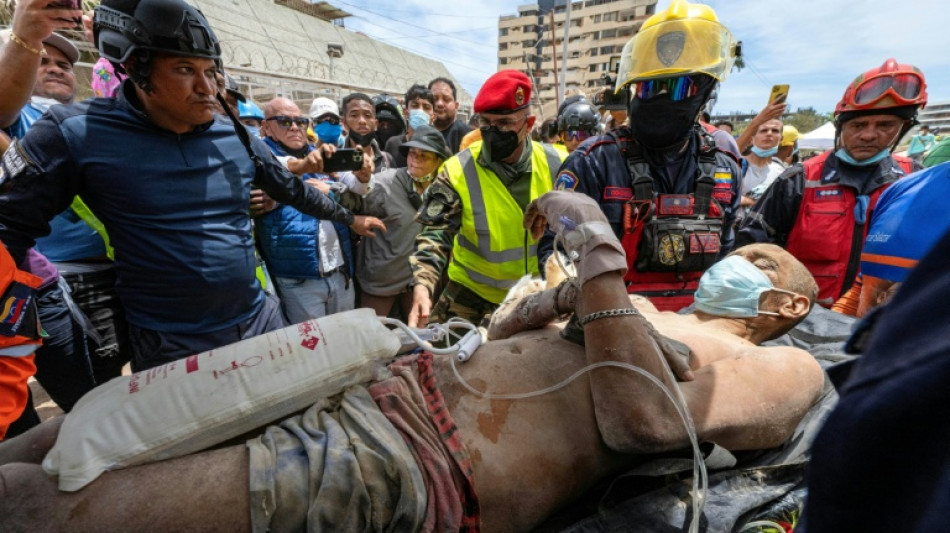
A man and his teen son were found alive Sunday under the rubble in Venezuela four days after powerful twin earthquakes rocked the country, as the death toll hit 1,450 and hopes of such rescues dwindled.
AFP journalists saw French and American rescue teams carry the son and his father down from a mountain of debris on stretchers, both visibly exhausted and in shock, in the devasted coastal town of Caraballeda, about 40 kilometers north of Caracas.
Tens of thousands of people were still reported missing, in a South American country already mired in economic crisis and political limbo after US forces captured former president Nicolas Maduro in January.
Millions more people were feared to lack sanitation and other basic needs after one of Latin America's most devastating earthquake disasters.
Rescue teams from the United States, Mexico and elsewhere scrambled to save people as desperate residents dug by hand for relatives trapped in the pancaked layers and rubble of collapsed apartments.
Some 774 buildings were badly damaged in back-to-back quakes of magnitude 7.2 and 7.5 that struck on Wednesday evening, including 189 buildings that have totally collapsed, National Assembly President Jorge Rodriguez said Sunday.
In one of the worst-hit areas, the coastal city of La Guaira, Hector Aguilera came to search for four family members buried in the rubble. Two other relatives were rescued.
"We don't have the support to get our family out -- we can't do it alone. They are buried there: we know they are dead, but here we are," he said.
"We have no hope left; all I have are memories."
Experts say the first 72 hours after natural disasters -- a period which has now passed in Venezuela -- are the narrow window for finding the living. After that the search usually becomes one of recovering bodies.
In the San Bernardino neighborhood of Caracas, volunteer rescuers clambered over a collapsed building, using drills to break up concrete and forming lines to remove rubble by hand.
In Chacao, another area of the capital, large electronic screens on a building usually used for advertising were showing the faces of missing people in a bid to help find them.
On Sunday, Rodriguez reported 1,450 dead -- a toll expected to rise -- with 3,150 people injured.
- 'Source of hope' -
Interim Venezuelan President Delcy Rodriguez said Saturday that rescuers had pulled 33 people from the ruins.
US helicopters ferried in aid, but hope had been running out for more people to be pulled out alive.
A Salvadoran rescue worker who declined to give his name put it this way: "At this point, they are probably dead bodies. Thanks to God maybe we can find people still alive."
An 11-year-old boy was rescued from the rubble Saturday in Caraballeda, north of Caracas, Rodriguez said.
"Every life is a source of hope for Venezuela," she said in an X post accompanied by a video of the rescue.
Facing public outrage at the response by local officials, Rodriguez thanked other countries for the outpouring of aid.
Twenty-four nations have sent 521 tons of supplies, 86 units with dogs trained to locate people trapped beneath the rubble and more than 2,700 search-and-rescue personnel, she said.
The United States said Saturday that one runway at Simon Bolivar International Airport, which serves the capital, was partially functioning to receive US military planes, while a naval ship had arrived off the coast. The US has also sent a 250-strong disaster response team.
- Economic impact -
The UN migration agency said that based on population and damage data, up to 6.76 million people could be affected, and would require shelter, water, sanitation, healthcare and essential relief items.
Venezuela's worst earthquakes in more than a century have come after the oil-rich country endured more than a decade of economic collapse.
The crisis has hollowed out hospitals and public services, driving millions to leave the country.
The United Nations estimated $6.7 billion in physical damage from Wednesday's earthquakes -- equivalent to six percent of Venezuela's GDP.
The government has restricted access to La Guaira state, deployed the military to the area and required volunteers to obtain a safe-entry pass.
Anger among those impatiently waiting to volunteer surged as they stood by for passes outside a concert hall in Caracas.
"You need a permit to save lives -- just imagine," complained Carlos Itriago, 27.
C.W.Kuhn--BlnAP