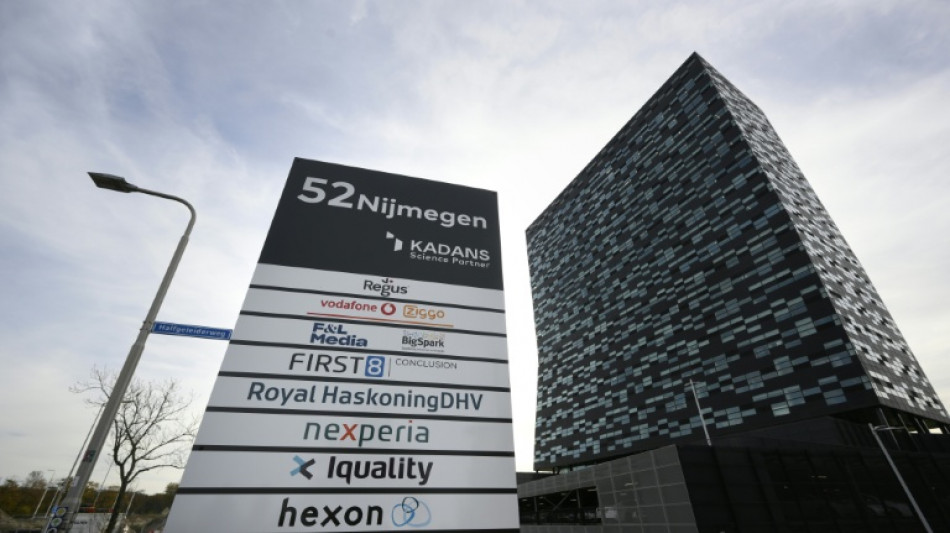
Nexperia's China unit nears fully local production of chips: company sources / Photo: JOHN THYS - AFP/File

 London
 24 °C
24 °C

 Manchester
 18 °C
18 °C
 Glasgow
16 °C
Glasgow
16 °C
 Dublin
 24 °C
24 °C
 Belfast
23 °C
Belfast
23 °C
 Washington
22 °C
Washington
22 °C
 Denver
 14 °C
14 °C
 Atlanta
28 °C
Atlanta
28 °C
 Dallas
29 °C
Dallas
29 °C
 Houston Texas
30 °C
Houston Texas
30 °C
 New Orleans
30 °C
New Orleans
30 °C
 El Paso
19 °C
El Paso
19 °C
 Phoenix
29 °C
Phoenix
29 °C
 Los Angeles
20 °C
San Diego
Los Angeles
20 °C
San Diego
 21 °C
San Francisco
14 °C
Chicago
16 °C
Minneapolis
11 °C
Seattle
11 °C
Portland
14 °C
Salt Lake City
16 °C
Las Vegas
24 °C
Miami
29 °C
Jacksonville
27 °C
San Antonio
28 °C
Bermuda
30 °C
Nassau
17 °C
Iqaluit
3 °C
Yellowknife
12 °C
Anchorage
21 °C
San Francisco
14 °C
Chicago
16 °C
Minneapolis
11 °C
Seattle
11 °C
Portland
14 °C
Salt Lake City
16 °C
Las Vegas
24 °C
Miami
29 °C
Jacksonville
27 °C
San Antonio
28 °C
Bermuda
30 °C
Nassau
17 °C
Iqaluit
3 °C
Yellowknife
12 °C
Anchorage
 9 °C
Fairbanks
7 °C
Barrow
-2 °C
Calgary
11 °C
Edmonton
27 °C
Winnipeg
10 °C
Goose Bay
11 °C
Halifax
15 °C
Boston
16 °C
Ottawa
12 °C
Toronto
12 °C
Detroit
14 °C
Cleveland
16 °C
New York
19 °C
Baltimore
22 °C
Philadelphia
20 °C
Nuuk (Godthåb)
4 °C
Hong Kong
9 °C
Fairbanks
7 °C
Barrow
-2 °C
Calgary
11 °C
Edmonton
27 °C
Winnipeg
10 °C
Goose Bay
11 °C
Halifax
15 °C
Boston
16 °C
Ottawa
12 °C
Toronto
12 °C
Detroit
14 °C
Cleveland
16 °C
New York
19 °C
Baltimore
22 °C
Philadelphia
20 °C
Nuuk (Godthåb)
4 °C
Hong Kong
 29 °C
Singapore
27 °C
Melbourne
29 °C
Canberra
9 °C
Adelaide
29 °C
Singapore
27 °C
Melbourne
29 °C
Canberra
9 °C
Adelaide
 11 °C
Darwin
24 °C
Perth
15 °C
Fort Worth
28 °C
Honolulu
26 °C
Sydney
15 °C
Johannesburg
23 °C
Dubai
37 °C
Mumbai
26 °C
Zürich
22 °C
Tokyo
24 °C
Seoul
19 °C
Delhi
30 °C
Beijing
21 °C
Riyadh
37 °C
Prague
17 °C
Pennsylvania
18 °C
Valletta
28 °C
Manama
35 °C
Warsaw
13 °C
Stockholm
15 °C
11 °C
Darwin
24 °C
Perth
15 °C
Fort Worth
28 °C
Honolulu
26 °C
Sydney
15 °C
Johannesburg
23 °C
Dubai
37 °C
Mumbai
26 °C
Zürich
22 °C
Tokyo
24 °C
Seoul
19 °C
Delhi
30 °C
Beijing
21 °C
Riyadh
37 °C
Prague
17 °C
Pennsylvania
18 °C
Valletta
28 °C
Manama
35 °C
Warsaw
13 °C
Stockholm
15 °C
The domestic unit of the Chinese-owned, Dutch-headquartered chipmaker Nexperia will soon be able to produce semiconductors locally within China, according to two company sources.
Nexperia is at the centre of a global tug-of-war over critical semiconductor technology, with a Dutch court in February ordering a probe into alleged mismanagement at the company.
The geopolitical tussle has disrupted supply chains, with some carmakers reportedly forced to cut production due to chip shortages.
Local production would allow Nexperia's domestic arm, Nexperia China, to bypass restrictions in place since October on the supply of silicon wafers -- etched with tiny components to make chips -- from Nexperia factories in Europe to China.
"From a supply chain perspective, we have completed the shift from global to domestic production in China," a Nexperia China representative told potential clients at a company event in Beijing on Wednesday.
The representative assured attendees that the domestically made chips would meet the same stringent quality standards as previous products.
"Because the Dutch side cut our wafer supply, we have to use domestically made wafers. In the future, all products will be full local production," a source close to the matter told AFP, who asked not to be named as they were not authorised to speak to media.
Nexperia's China unit could achieve full localisation for most of its chips in the second half of 2026, including ones widely used in car production, he said.
AFP contacted both Nexperia and Nexperia China for official comment but had no immediate response.
- Tug of war -
The Nexperia saga kicked off in September 2025 when the Dutch government invoked a Cold War-era law to effectively seize control of Nexperia, which is based in the Dutch city of Nijmegen.
Once part of Dutch electronics giant Philips, it was acquired in 2018 by China's Wingtech.
Nexperia's Dutch headquarters has since cut off access to its office systems for employees in China, causing "significant disruption" to operations, the Chinese unit said in a statement last month.
Nexperia microchips are mainly found in cars, but also industrial components, as well as consumer appliances and electronics, such as refrigerators.
Prior to the seizure, Nexperia typically produced wafers in Europe and then sent them for packaging into finished chips in China and Southeast Asia.
Beijing retaliated to the seizure in October with export controls on products made by Nexperia in China -- a blow to the company's business -- but has since re-allowed exports for civilian use.
The resumption of shipments was part of a trade deal agreed by Chinese President Xi Jinping and his US counterpart Donald Trump after talks in South Korea last October, the Wall Street Journal reported at the time.
Nexperia said in late October that it had suspended direct wafer supplies to its Chinese unit. The suspension remains in place.
The latest development comes just weeks after Nexperia China announced it had started producing several types of chips using domestically made 12-inch wafers.
Similar chips made by its Chinese-owned Dutch parent use less advanced 8-inch wafers from Germany.
Nexperia China's packaging factory in the manufacturing hub of Dongguan is currently operating at about 60-70 percent of its original production capacity using stockpiles, client-supplied wafers and alternative domestic suppliers, the source close to the matter told AFP.
The company is on track to resume up to 90 percent production capacity for its popular products in the second quarter of this year, he said.
The China unit's main production now centers on a packaging factory in Dongguan and a wafer factory in Shanghai, supplemented by contracted external suppliers for additional packaging and wafer capacity.
"Nexperia China's future focus will be on these two factories (in Dongguan and Shanghai)," the source said.
"They will serve as the main production centres for our products."
N.Mahnke--BlnAP