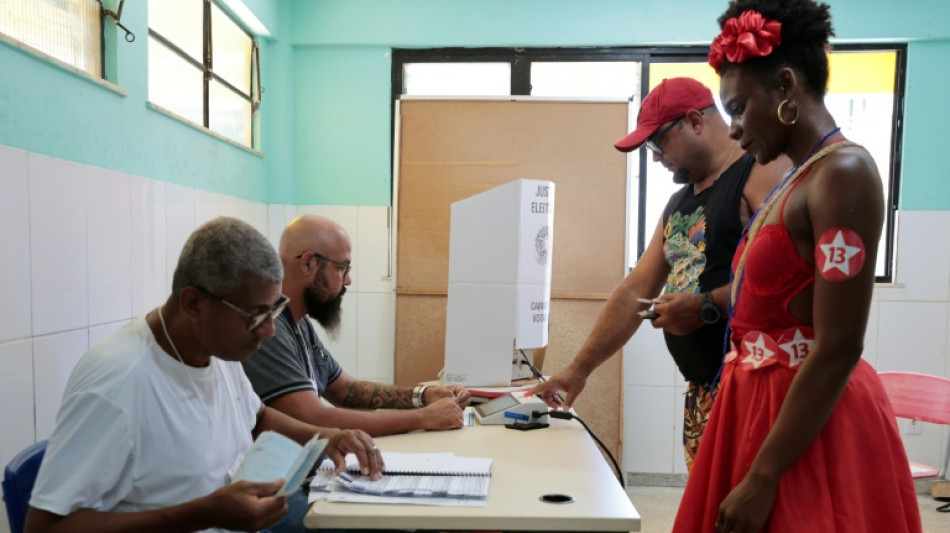
Brazil voting extended in tight race between Lula, Bolsonaro / Photo: Antonello VENERI - AFP

 London
 9 °C

 Manchester
9 °C
 Glasgow
 10 °C
 Dublin
 9 °C
 Belfast
 8 °C
 Washington
 18 °C
 Denver
 13 °C
 Atlanta
 21 °C
 Dallas
26 °C
 Houston Texas
26 °C
 New Orleans
24 °C
 El Paso
25 °C
 Phoenix
27 °C
 Los Angeles
26 °C
San Diego
27 °C
San Francisco
22 °C
Chicago
23 °C
Minneapolis
12 °C
Seattle
12 °C
Portland
 10 °C
Salt Lake City
15 °C
Las Vegas
23 °C
Miami
24 °C
Jacksonville
20 °C
San Antonio
27 °C
Bermuda
 21 °C
Nassau
16 °C
Iqaluit
 -4 °C
Yellowknife
1 °C
Anchorage
5 °C
Fairbanks
 1 °C
Barrow
0 °C
Calgary
1 °C
Edmonton
22 °C
Winnipeg
5 °C
Goose Bay
12 °C
Halifax
13 °C
Boston
15 °C
Ottawa
17 °C
Toronto
16 °C
Detroit
19 °C
Cleveland
18 °C
New York
18 °C
Baltimore
17 °C
Philadelphia
17 °C
Nuuk (Godthåb)
-6 °C
Hong Kong
24 °C
Singapore
26 °C
Melbourne
26 °C
Canberra
11 °C
Adelaide
 10 °C
Darwin
29 °C
Perth
12 °C
Fort Worth
26 °C
Honolulu
28 °C
Sydney
18 °C
Johannesburg
21 °C
Dubai
31 °C
Mumbai
30 °C
Zürich
8 °C
Tokyo
20 °C
Seoul
15 °C
Delhi
19 °C
Beijing
10 °C
Riyadh
27 °C
Prague
8 °C
Pennsylvania
15 °C
Valletta
20 °C
Manama
30 °C
Warsaw
8 °C
Stockholm
10 °C
Brazil's Supreme Court extended voting time for two hours in a knife-edge election race Sunday between right-wing senator Flavio Bolsonaro and leftist incumbent Luiz Inacio Lula da Silva, who complained that citizens were unable to reach polling stations due to transport problems.
Lula, 80, had asked the courts to extend voting, claiming buses had been pulled from circulation in Sao Paulo and key northeastern cities, a bastion of his support, claiming "something abominable is happening."
A Supreme Court ruling just minutes after polls were to close at 5 pm (2000GMT) local time, ordered voting extended across the country until 7 pm, citing the "seriousness of the facts narrated."
Lula is facing stiff competition from Flavio Bolsonaro, who stunned the left by winning the most votes in a first-round election three week ago.
Final polls showed the pair neck-and-neck in Sunday's runoff.
Lula said that 40 percent of buses were pulled from service in Sao Paulo, a problem also seen in several cities in northeastern Brazil, where he held a commanding lead in the first round.
A regional electoral court ordered the arrest of Salvador's transport secretary for failing to offer free transport on election day, while local media reported that 75 buses had been prevented from leaving garages in the city.
Flavio Bolsonaro, 45, the son of jailed former president Jair Bolsonaro, also asked for an extension due to heavy rains in the south and southeast of Brazil -- where much of his support is concentrated.
- 'We are watching' -
Sunday's runoff will determine whether Brazil remains one of Latin America's few leftist nations or joins a regional swing to the right championed by US President Donald Trump.
Lula, who is seeking a fourth non-consecutive term, has pitched himself as a bulwark against US interference and democratic backsliding.
Trump, an ally of Flavio Bolsonaro's father, simply said "we are watching, yeah," when asked about Brazil's election on Sunday.
The 45-year-old senator has vowed to crack down on crime and slash government spending, while handing Brazil to "the Lord Jesus Christ."
"The time has come for real change," he declared after voting in Rio de Janeiro.
"This is about renewal, enough of the same old thing," 67-year-old retiree Eduardo Viana told AFP, adding that Lula "says he governs for the poor...just look, people can't even go to the supermarket."
Bolsonaro presents himself as more moderate than his firebrand father, who is serving a 27-year sentence for plotting a coup after he lost in the 2022 elections.
After its first-round defeat, the left swung into action with massive rallies highlighting Jair Bolsonaro's chaotic handling of the Covid pandemic, devastation of the Amazon rainforest and cuts to public programs.
Deforestation of the world's largest rainforest has hit its lowest level in four decades under Lula.
Yet, as the El Nino weather phenomenon fueled fires across the Amazon in recent weeks, and rains lashed the south, climate change barely featured in the campaign.
- Lula's revamp -
Lula, revered for social welfare programs that lifted millions out of poverty, made a dramatic comeback to office in 2022 elections after a corruption scandal saw him jailed for over 18 months.
The charges, annulled on procedural grounds, have continued to haunt him.
In his third term he has overseen a drop in inflation and unemployment, and lifted millions out of hunger, but voters complain about the cost of living and a sense of insecurity.
After his first-round blow, Lula revamped his social media strategy and even bought his first cellphone.
A fierce social media battle drew in Meta, parent company of WhatsApp, Facebook and Instagram, which Lula's campaign accused of favoring his opponent with "algorithmic manipulation."
Meta denied this but acknowledged that some of Lula's campaign ads had been mistakenly deactivated due to technical errors.
The bitterly divisive campaign alienated many voters, including doorman Joao Inacio Oliveira, who told AFP he would make a last-minute decision at the polling station.
"I don't know who I'm going to vote for," said Oliveira, 72. "I don't have any hope in the governments that come and go in Brazil."
W.Hansen--BlnAP